Home
SalatWuduQuranPrayer TimesExplore
A path for everyone
Hanafi School

يَا أَيُّهَا ٱلَّذِينَ ءَامَنُوٓا۟ إِذَا قُمْتُمْ إِلَى ٱلصَّلَوٰةِ فَٱغْسِلُوا۟ وُجُوهَكُمْ وَأَيْدِيَكُمْ إِلَى ٱلْمَرَافِقِ وَٱمْسَحُوا۟ بِرُءُوسِكُمْ وَأَرْجُلَكُمْ إِلَى ٱلْكَعْبَيْنِ

"O you who have believed, when you rise to perform prayer, wash your faces and your forearms to the elbows, and wipe over your heads, and wash your feet to the ankles."

Sūrah al-Māʾidah · 5:6 · Sahih International

Wudu is the foundation of Salat. The Prophet ﷺ said: 'No prayer is accepted without purification.' (Sahih Muslim 224) Without wudu, no prayer is valid — and so this short ritual is one of the first things every Muslim learns.

This page covers wudu in two parts: first the four obligatory acts (the bare minimum for valid wudu), then the complete prophetic method with all the recommended sunnahs that bring greater reward.

Part one

The four obligatory acts

These are the minimum requirements for wudu to be valid. They come directly from Sūrah al-Māʾidah 5:6. If any one of these four is missed, the wudu is invalid and any prayer performed with it is also invalid.

Note: the requirement is that water reaches every part of the limb at least once. Washing three times is sunnah on top of this — the farḍ is fulfilled by a single thorough wash.

1

Wash the face

غَسْلُ الْوَجْه

Wash the entire face once — from the hairline above the forehead to underneath the chin, and from one earlobe to the other. Water must flow over every part of the visible face. Men with thick beards must let water reach the skin underneath; running wet fingers through the beard (khilāl al-liḥya) is an established sunnah of the Prophet ﷺ for those whose beards conceal the skin.

2

Wash the arms to the elbows

غَسْلُ الْيَدَيْنِ إِلَى الْمِرْفَقَيْن

Wash both arms once — from the fingertips up to and including the elbows. The elbows themselves must be washed; this is a commonly missed area. Make sure water reaches between the fingers.

Common mistake The farḍ wash of the arm includes the entire hand, not just from the wrist upward. If you washed your hands as a sunnah at the start of wudu and then only wash from the wrist to the elbow at this step, the obligatory act is not fulfilled. The full hand must be washed again as part of this step, even if it has just been washed.
3

Wipe (masaḥ) the head

مَسْحُ الرَّأْس

Wipe at least one quarter of the head with wet hands. Note: this is a wipe, not a wash — water flows from the hand onto the head, not from above. Use fresh water on your hands rather than the wetness left over from washing the arms. This is the Hanafi position; other schools differ on the amount required.

4

Wash the feet to the ankles

غَسْلُ الرِّجْلَيْنِ إِلَى الْكَعْبَيْن

Wash both feet once — up to and including the ankle bones. The Prophet ﷺ once warned: 'Woe to the heels from the Fire' (Bukhari 60, Muslim 241) — referring to those who leave their heels dry during wudu. Make sure water reaches every part of the foot, including between the toes.

Part two

The complete prophetic method

This is wudu as the Prophet ﷺ performed it — the four farḍ acts above plus all the sunnah acts that surround them. Each washed limb is done three times, beginning with the right side. The first wash fulfils the farḍ; the second and third bring greater reward.

1

Make the intention (niyyah)

النِّيَّة

Intend in your heart that you are performing wudu for the sake of Allah, in order to be in a state of purity for prayer. Note: in the Hanafi school, niyyah is sunnah for wudu, not farḍ — but it should never be neglected, as it transforms a physical wash into an act of worship.

2

Say Bismillāh

التَّسْمِيَة

Begin by saying Bismillāh'In the name of Allah'. The Prophet ﷺ said: 'There is no wudu for the one who does not mention the name of Allah upon it.' (Tirmidhi 25, Ibn Majah 397)

3

Wash both hands to the wrists

غَسْلُ الْيَدَيْن

Wash both hands up to the wrists three times, beginning with the right. Make sure water reaches between the fingers. If you wear a ring, move it back and forth so water reaches the skin underneath.

4

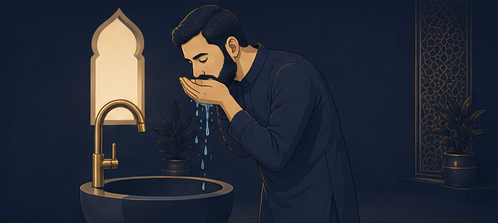
Rinse the mouth (madmadah)

الْمَضْمَضَة

Take water into the mouth and swirl it around three times, then spit it out. If you are not fasting, gargle gently. Using a miswak (or your finger) to clean the teeth before this is itself a sunnah of the Prophet ﷺ.

5

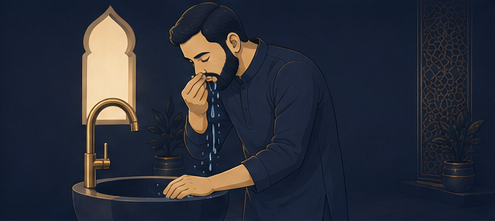
Rinse the nose (istinshāq)

الْاِسْتِنْشَاق

Use the right hand to draw water gently into the nostrils, then use the left hand to blow it out. Repeat three times. Avoid being excessive if you are fasting.

6

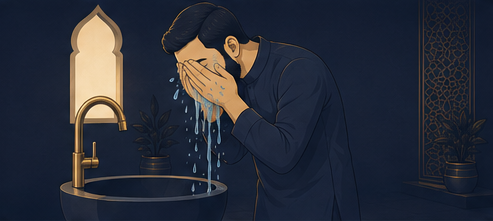
Wash the face three times

غَسْلُ الْوَجْه

Wash the entire face three times — hairline to chin, ear to ear. The first wash fulfils the farḍ; the second and third are sunnah.

For those with thick beards: run wet fingers through the beard (khilāl al-liḥya) so water reaches the skin underneath. This is an established sunnah of the Prophet ﷺ.
7

Wash the arms three times

غَسْلُ الذِّرَاعَيْن

Wash the right arm three times from fingertips to elbow (including the elbow), then the left arm three times. Run wet fingers between the fingers of each hand (this is called khilāl al-aṣābiʿ).

8

Wipe the head once

مَسْحُ الرَّأْس

Wet both hands with fresh water. Place them on the front of the head and pass them backwards to the nape of the neck, then return them to the front. This is done only once.

9

Wipe the ears

مَسْحُ الْأُذُنَيْن

Without taking new water, use your index fingers to wipe the inside of each ear, and your thumbs to wipe behind each ear. The same wetness from wiping the head is used.

10

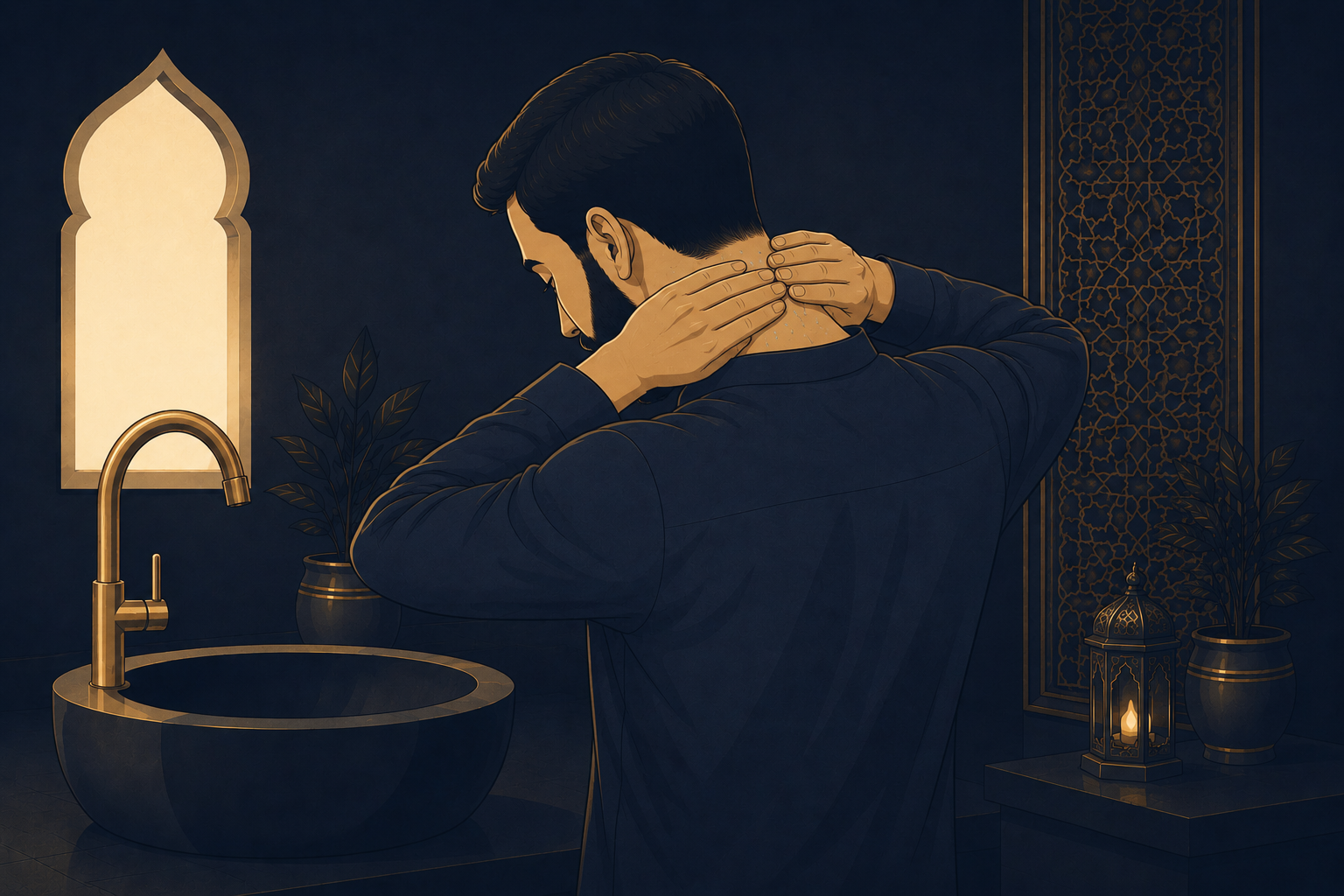
Wipe the back of the neck (mustaḥabb)

مَسْحُ الرَّقَبَة

Using the back of your wet fingers, wipe the back of the neck once, with the wetness remaining from the head wipe. Note: classical Hanafi texts (Quduri, Nūr al-Īḍāḥ) include this as mustaḥabb — a recommended act of devotion. Some contemporary scholars consider the supporting narrations weak. It remains a deeply rooted practice in many Hanafi communities.

Important: the wipe is for the back of the neck only. Traditional manuals explicitly warn against wiping the front of the neck or throat, which is regarded as an innovation (bidʿah).
11

Wash the feet three times

غَسْلُ الْقَدَمَيْن

Wash the right foot three times, then the left foot three times. Run wet fingers between the toes (the khilāl of the toes — use the little finger of the left hand). Make sure the heels and ankles are thoroughly washed.

Guiding principles

The sunnah beneath the steps

Beyond the individual steps, the prophetic method follows a few overarching principles. In the Hanafi school these are sunnah or mustaḥabb — they enrich the wudu without being conditions of validity.

Sequence

التَّرْتِيب

Performing the four obligatory acts in the order Allah mentioned them in 5:6 — face, arms, head, feet. Sunnah in Hanafi; it is farḍ in the Maliki and Shafiʿi schools.

Continuity

الْمُوَالَاة

Performing the steps one after another without long pauses, so that no limb dries before the next is washed. Sunnah in Hanafi; farḍ in Maliki.

Rubbing the limbs

الدَّلْك

Actively rubbing the skin while washing rather than just letting water flow over it. Sunnah in Hanafi; farḍ in Maliki. It also helps water reach every part properly.

Right side first

التَّيَامُن

Beginning with the right hand, the right arm, the right foot. The Prophet ﷺ 'loved to begin with the right in all things' (Bukhari 168) — this carries through every act of worship.

Three times

التَّثْلِيث

Washing each part three times rather than once. The first wash fulfils the obligation; the second and third are sunnah. The Prophet ﷺ would also sometimes perform wudu washing each part only once.

Avoid these

Common mistakes to avoid

These are errors that frequently invalidate wudu without the person realising. Each one is genuinely common — even among lifelong practitioners.

Missing the elbows

Many people wash up to but not including the elbow. The elbow joint must be fully wetted. The Arabic ilā l-marāfiq in 5:6 has been interpreted by the four schools as up to and including the elbows.

Dry heels

The Prophet ﷺ warned: 'Woe to the heels from the Fire' (Bukhari 60). This referred to people who poured water over their feet without rubbing — the heels and the area between the toes were left dry. Always make sure water reaches everywhere.

Wrist-only after washing hands

If you wash your hands as a sunnah at the start of wudu and then only wash from the wrist upward at the obligatory arm-washing step, the obligation is not fulfilled. The farḍ wash includes the entire hand and forearm together — the full hand must be re-included.

Nail polish that blocks water

Standard nail polish forms a waterproof barrier and prevents water from reaching the nail, which means the wash is invalid. It must be removed before wudu. So-called water-permeable polishes are debated — most scholars recommend removing them to be safe.

Rings, watches, and bandages

Tight rings or watches can leave a strip of skin dry. Move them back and forth during the wash so water reaches underneath. Bandaged wounds (jabīrah): wipe over the bandage instead — this substitutes for washing the part underneath.

Wiping the head with too little water

The hands must be genuinely wet, not just damp. Use fresh water on your hands for the head wipe — not the leftover wetness from washing the arms.

Using wudu water that has already been used

In the Hanafi school, water that has dripped off a limb during wudu (māʾ mustaʿmal) is considered ritually unfit for performing another wudu, although it remains physically clean.

Excessive water use (isrāf)

The Prophet ﷺ warned against being wasteful with water during wudu, even at the bank of a flowing river. Wudu is a purification, not a wash — let the water reach what it needs to reach, and no more.

Part three

The duʿā after wudu

It is sunnah to recite the following testimony and supplication immediately after completing your wudu. Do not recite it inside the bathroom — step out first if needed.

Recite
أَشْهَدُ أَنْ لَا إِلَٰهَ إِلَّا ٱللَّٰهُ وَحْدَهُ لَا شَرِيكَ لَهُ، وَأَشْهَدُ أَنَّ مُحَمَّدًا عَبْدُهُ وَرَسُولُهُ ۝ ٱللَّٰهُمَّ ٱجْعَلْنِي مِنَ ٱلتَّوَّابِينَ، وَٱجْعَلْنِي مِنَ ٱلْمُتَطَهِّرِينَ
Ashhadu an lā ilāha illa llāh, waḥdahu lā sharīka lah, wa ashhadu anna Muḥammadan ʿabduhu wa rasūluh · Allāhumma jʿalnī mina t-tawwābīna, wa jʿalnī mina l-mutaṭahhirīn
I bear witness that there is no god except Allah alone, with no partner, and I bear witness that Muhammad ﷺ is His servant and messenger. O Allah, make me among those who turn to You in repentance, and make me among those who purify themselves.
Jamiʿ at-Tirmidhī 55 — narrated by ʿUmar ibn al-Khaṭṭāb. The Prophet ﷺ said whoever performs wudu well and recites this, the eight gates of Paradise are opened for him.
Part four

What breaks wudu

Once you have wudu, you remain in a state of purity until one of the following occurs. When wudu is broken, it must be performed again before the next prayer.

Using the toilet

Any discharge from the front or back passages — urine, stool, or passing wind — breaks wudu.

Sleep

Deep sleep that causes loss of awareness breaks wudu. Light dozing while sitting upright does not.

Loss of consciousness

Fainting, unconsciousness, intoxication, or anything that causes loss of awareness.

Bleeding or pus

In the Hanafi school, blood or pus that flows from a wound — to the point that it would need to be wiped away — breaks wudu.

Vomiting

A mouthful of vomit (in the Hanafi school) breaks wudu.

Loud laughter in prayer

In the Hanafi school, audible laughter during the prayer itself breaks both the prayer and the wudu — though laughter outside prayer does not.

Note for those familiar with other schools

In the Hanafi school, the following do not break wudu, even though you may have heard otherwise from other schools:

Touching a person of the opposite gender, even with desire (this is held to break wudu in the Shafiʿi school, but not in Hanafi).

Touching one's own private parts (held to break wudu in Shafiʿi, not in Hanafi).

Eating camel meat (held by some schools to break wudu, not in Hanafi).

Bleeding from a wound that does not flow, such as a small drop that does not need wiping.

If you grew up in a household that followed a different school and avoided wudu after these things, that is correct for that school — and you may continue that practice as a precaution if it gives you peace of mind. But it is not required of you in the Hanafi school.

Doubt vs certainty

A practical Hanafi principle: al-yaqīn lā yazūlu bi-sh-shakk"certainty is not removed by doubt."

If you had wudu and now doubt whether something has broken it, you are still in wudu. Conversely, if you were not in wudu and doubt whether you performed it, you are not. Act on what you are certain of, not on what you suspect. This protects against the spiritual disease of waswās — obsessive doubt.

Practical notes

Special situations

Wiping over socks (masaḥ ʿalā l-khuffayn)

Once-relevant ruling

If you put on leather socks (or thick socks meeting certain conditions) while in a state of wudu, you may wipe over them rather than washing the feet when renewing wudu. The duration is 24 hours for a resident and 72 hours for a traveller, beginning from the moment wudu is first broken after putting them on.

To wipe: with wet fingers, wipe the top of each sock once, drawing your fingers from the toes towards the shin. The bottom of the sock is not wiped.

When water is unavailable (tayammum)

Dry ablution

If water is genuinely unavailable, or using it would cause harm (illness, severe cold with no shelter, etc.), Allah has permitted tayammum — a symbolic ablution using clean earth or dust.

The method: with the intention of purification, strike the palms once on a clean dusty or earthen surface, blow off any excess, and wipe the entire face once. Then strike the palms again, and wipe each arm up to and including the elbow, beginning with the right. Tayammum is then complete and replaces wudu for one prayer.

Renewing wudu before each prayer

Sunnah of the Prophet ﷺ

It is sunnah to renew wudu before each prayer even if your existing wudu has not broken. The Prophet ﷺ used to do this. Each renewal is recorded as a separate act of purification and brings additional reward.

That said, performing a single prayer with one wudu (and several prayers with the same wudu if it has not broken) is also entirely valid — renewal is recommended, not required.

Wounds and bandages (jabīrah)

When water cannot reach a part of the body

If part of the body is bandaged, splinted, or in a cast — and removing the covering would harm the wound or be impractical — you wipe over the covering with wet fingers in place of washing the part underneath. This is called the jabīrah ruling. Any uncovered area should still be washed normally.

If wiping over the covering would itself cause harm (for example, a fresh open wound), that part is omitted entirely and the rest of wudu is completed as normal.

Conserving water

The prophetic example

The Prophet ﷺ would perform wudu with very small amounts of water — sometimes as little as a single mudd (about 750ml). He warned against being excessive even at the bank of a flowing river. Wudu is a purification, not a wash — let the water reach what it needs to reach, and no more.

You are ready to pray

With wudu complete, you are in a state of purity and ready to stand before Allah in prayer. The Prophet ﷺ said: 'When a Muslim performs wudu and washes his face, every sin he committed with his eyes is washed away with the water...' (Sahih Muslim 244)

Learn to Pray Salat View Prayer Times

Sources & References

The content on this page has been compiled and cross-referenced against the following authoritative Hanafi sources, classical fiqh manuals, and authentic ḥadīth collections.

A note on accuracy: This guide has been prepared with careful research and cross-referencing, but we are not scholars of Islamic jurisprudence. It is intended as a learning aid, not as a substitute for formal study or scholarly guidance.

If you have personal questions about your wudu, please consult a qualified local imam or trusted scholar. If you find any error on this page, please contact us — we take this responsibility seriously and will correct it immediately.

May Allah accept the effort and forgive any shortcomings.